
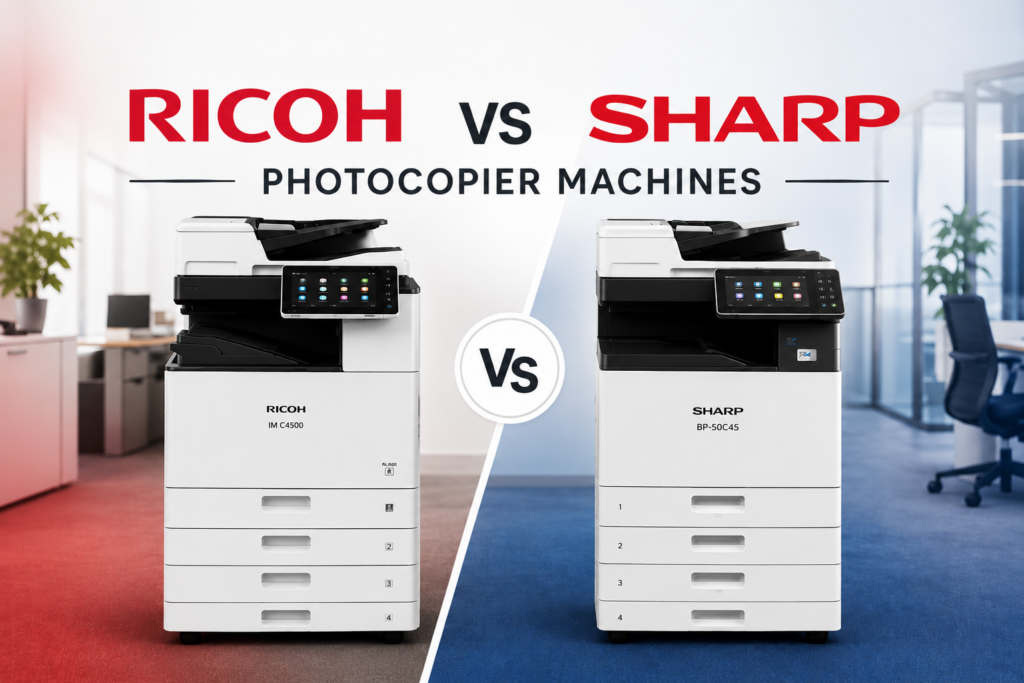
When comparing office photocopiers, Ricoh and Sharp are two brands that regularly appear on business shortlists. Both offer reliable multifunction devices designed for modern workplaces, but they each suit different types of business environments and printing needs.
If you are deciding between the two, here is a quick overview of how Ricoh and Sharp compare.
Key Differences
| Feature | Ricoh | Sharp |
| Reliability | Excellent | Very strong |
| Ease of Use | Good | Excellent |
| Workflow Features | Advanced | User-friendly |
| Best For | High-volume businesses | General office environments |
| Running Costs | Cost-efficient | Competitive |
| Interface | Feature-rich | Simple & intuitive |
| Scalability | Strong | Moderate to strong |
Ricoh Copiers
Ricoh copiers are known for high-volume performance, workflow automation, strong scanning capabilities, and efficient running costs. Ricoh copiers are often chosen by larger businesses, document-heavy environments, and teams with advanced workflow requirements. Their devices are designed for businesses that need scalability and productivity.
Sharp Copiers
Sharp copiers focus heavily on ease of use, simplicity, reliable day-to-day office printing, and straightforward interfaces. Sharp is popular with SMEs, general office environments, and businesses wanting simple operation without unnecessary complexity. Their touchscreen systems are often considered among the easiest to use.
Which Brand is Better?
There is no universal ‘best’ brand.
The right choice depends on your monthly print volume, office size, workflow complexity, budget, and service requirements.
Ricoh may suit you better if your business prints heavily, you need advanced workflows, and you require scalability.
Sharp may suit you better if ease of use is the priority, your office has more standard printing needs, and you want a simpler setup.
Both Ricoh and Sharp offer reliable office photocopiers with strong reputations across the UK market. Ricoh tends to stand out for advanced workflows and high-volume environments, while Sharp is often preferred for simplicity and usability.
The key is comparing machines based on how your business actually operates, not just choosing based on brand name alone.